

AI Agents with Persistent Memory and Reusable Skills: How They Work
Discover how AI agents use persistent memory and reusable skills to maintain context, remember important information, and perform recurring tasks more effectively. Learn the difference between agent memory and skills, how they work together, and what to look for when choosing an AI agent.
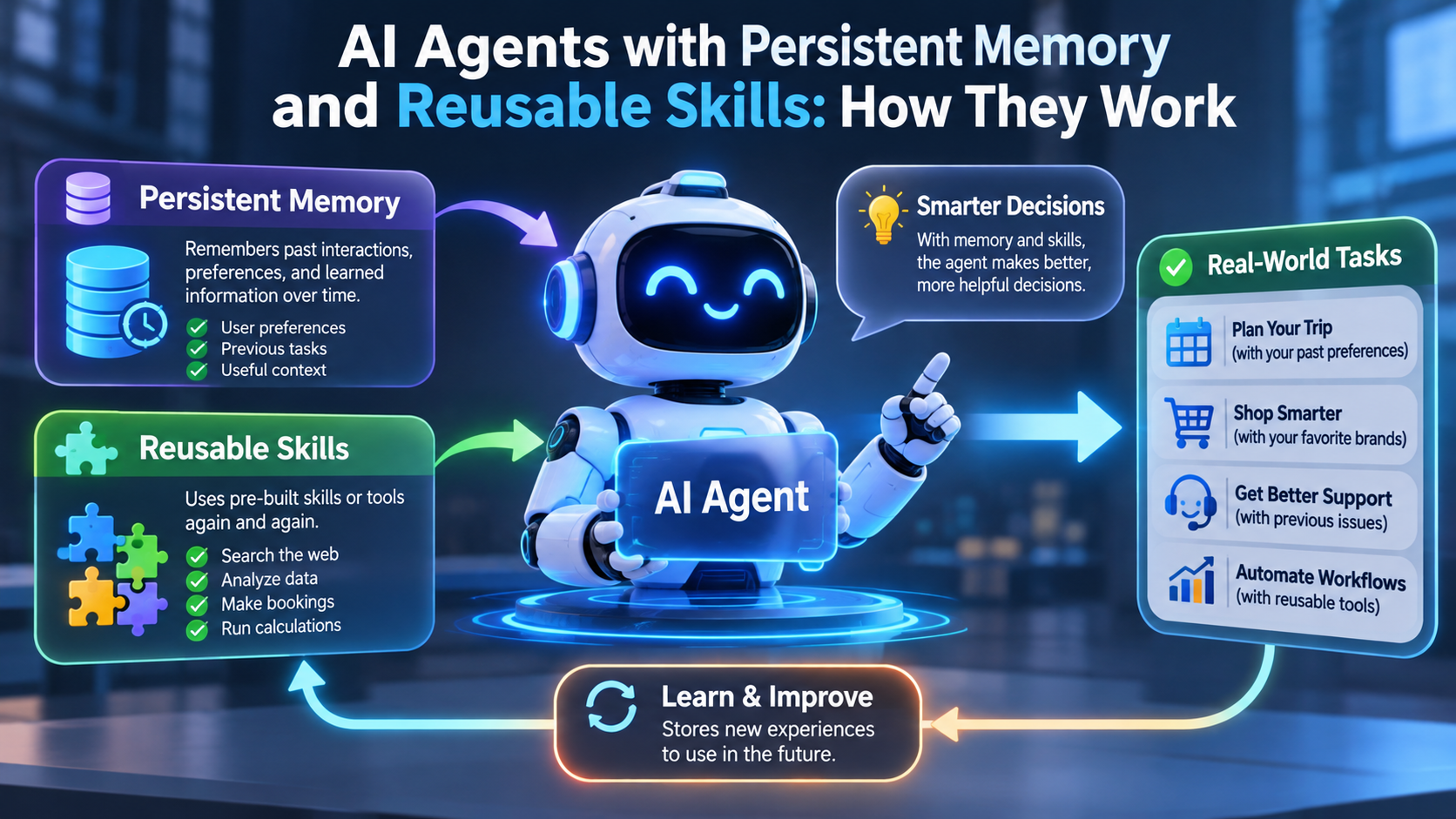
AI agents are becoming more capable of handling complex tasks. They can research information, organize projects, interact with applications, write code, manage workflows, and assist with everyday business operations.
But there is an important limitation: an AI agent that forgets everything after each interaction can become frustrating to use.
Imagine explaining your business, preferences, project requirements, and working process to an AI agent every time you start a new conversation. Even if the agent is intelligent, repeatedly providing the same information wastes time.
This is why two capabilities are becoming increasingly important in modern AI agents: persistent memory and reusable skills.
Persistent memory helps an AI agent retain useful information between sessions. Reusable skills give it structured instructions for completing tasks consistently.
Together, these capabilities make an AI agent more useful over time. Instead of simply responding to individual prompts, it can build continuity around projects and repeatable workflows.
In this guide, we'll explain how AI agent memory works, what reusable skills are, how they differ, and how they work together.
What Is an AI Agent with Persistent Memory?
An AI agent with persistent memory can retain selected information beyond a single conversation or task.
A basic AI interaction may use only the information available in the current context. Once the session ends, that context may no longer be available to a future session.
Persistent memory provides a way to store useful information externally and retrieve it when it becomes relevant again.
For example, imagine you use an AI agent to manage a business project.
During your first interaction, you explain:
- Your business name and industry.
- Your preferred communication style.
- Your current project goals.
- The tools your team uses.
- Important decisions made during the project.
With a properly configured memory system, the agent can retain selected details and use them in future interactions.
The next time you ask it to prepare a project update, it may already know the project background and your preferred report format.
You don't have to explain everything again.
Persistent memory does not mean the AI model has been retrained. In many agent systems, useful information is stored outside the model and retrieved when needed.
This distinction matters because memory can be updated, reviewed, organized, and deleted without changing the underlying model.
How Does AI Agent Memory Work?
An AI agent memory system usually involves several stages.
1. Information Collection
The agent receives information during interactions and task execution.
This may include user preferences, project instructions, important decisions, task outcomes, or information retrieved from connected tools.
However, a good memory system should not save every message automatically.
It should identify which information is likely to be useful in the future.
2. Memory Filtering
Before saving information, the system should evaluate its relevance and reliability.
For example:
- A long-term writing preference may be useful.
- A temporary question may not need to be saved.
- A completed task may be worth recording if it affects future work.
- A temporary password or API key should not be stored as ordinary memory.
Filtering prevents the memory store from becoming a collection of unrelated conversations.
3. Information Storage
Selected information is saved in a storage system.
Depending on the application, this could be structured data, files, a database, a searchable document store, or a vector database.
The storage method should match the information being retained.
For example, structured project status may belong in a database, while reusable instructions may be stored as files.
4. Memory Retrieval
When a new task begins, the agent searches for relevant information.
It does not necessarily need to load its entire memory into every interaction.
Instead, it can retrieve the information related to the current request.
For example, if you ask about a marketing campaign, the agent may retrieve campaign goals, previous decisions, and your preferred reporting format.
5. Memory Updates
Memory should also change when circumstances change.
A project may have a new deadline. A user may change their preferences. An old instruction may become obsolete.
A reliable system needs a way to update, correct, and remove outdated information.
This is what separates useful persistent memory from a folder of old conversation summaries.
The Main Types of AI Agent Memory
Not all memories serve the same purpose. Different types of information need different storage and retrieval strategies.
Here are four useful categories.
1. Working Memory
Working memory contains information the agent needs while performing its current task.
It can include:
- The current user request.
- Recent conversation messages.
- Intermediate reasoning context.
- Current task progress.
- Recent tool results.
For example, when an agent is researching a company, it may temporarily keep track of the sources it has checked and the questions it still needs to answer.
Working memory is useful during an active task, but it should not be confused with long-term memory.
2. Episodic Memory
Episodic memory records important events and previous interactions.
For example:
- A project was launched on a particular date.
- A previous deployment failed because of a configuration issue.
- A customer requested a specific change.
- A particular approach was successful in an earlier task.
The important detail is that episodic memory preserves the context of what happened.
Dates and sources are particularly valuable because information can become outdated.
3. Semantic Memory
Semantic memory stores general facts and knowledge that remain useful across different tasks.
Examples include:
- Company information.
- Product documentation.
- Business policies.
- Technical instructions.
- Frequently used project information.
Unlike episodic memory, semantic memory is not necessarily tied to one specific interaction.
It helps an AI agent access information it needs to understand a subject or make decisions.
4. Procedural Memory
Procedural memory describes how an agent should perform a task.
This is where reusable skills become especially useful.
Examples include:
- How to prepare a weekly business report.
- How to investigate a software error.
- How to organize research findings.
- How to process a customer support request.
- How to review a document using a defined checklist.
Procedural memory captures repeatable behavior rather than only facts.
What Are Reusable Skills in AI Agents?
Reusable AI agent skills are structured instructions that teach an agent how to perform a specific task or workflow.
Instead of writing a long prompt every time you need something done, you can define a skill once and make it available whenever the relevant task appears.
Consider a simple example.
You regularly ask your AI agent to prepare a weekly research report.
Without a reusable skill, you may need to explain the process every week:
- Search for relevant information.
- Check the source dates.
- Compare findings.
- Organize the results.
- Create a summary.
- Highlight important developments.
With a reusable skill, these instructions can be organized into a repeatable workflow.
When you request the report, the agent can use the relevant skill rather than relying on you to repeat the instructions.
A well-designed skill may contain:
- A clear skill name.
- A description of when to use it.
- Required inputs.
- Step-by-step instructions.
- Tools or integrations needed.
- Expected output format.
- Validation requirements.
- Conditions that require human approval.
Skills are not necessarily the same as tools.
A tool provides a capability, such as searching the web, reading a file, or sending an email.
A skill explains how to use one or more capabilities to complete a particular task.
For example, a web search tool can retrieve information. A research skill can explain how to search, evaluate sources, compare evidence, and prepare a report.
Persistent Memory vs. Reusable Skills: What Is the Difference?
Persistent memory and reusable skills work together, but they solve different problems.
| Capability | Persistent Memory | Reusable Skills |
|---|---|---|
| Main purpose | Retain useful information | Define how to perform tasks |
| Focus | What the agent knows | How the agent works |
| Examples | Preferences and project history | Report-writing workflow |
| When used | When relevant context is needed | When a matching task is requested |
| Main benefit | Continuity | Consistency |
Consider this example:
You ask an AI agent to prepare a monthly marketing report.
Its persistent memory may contain:
- Your company information.
- Previous marketing goals.
- Your preferred reporting format.
- The channels your business uses.
Its reusable reporting skill may contain:
- How to collect the data.
- Which metrics to compare.
- How to calculate changes.
- How to organize the findings.
- How to present recommendations.
The memory tells the agent what matters in your situation.
The skill tells the agent how to complete the task.
Together, they provide a more consistent experience.
How Persistent Memory and Reusable Skills Work Together
The real value appears when both capabilities are connected.
Imagine an AI agent that supports a small business.
During its first interactions, the agent learns the company's basic information and preferred communication style.
Later, the owner gives it a reusable customer support skill.
That skill explains how to classify incoming messages, find relevant product information, prepare a response, and escalate complaints that need human attention.
When a new customer message arrives, the agent can:
- Retrieve relevant company and product information from memory.
- Identify the appropriate customer support skill.
- Follow the defined workflow.
- Use connected tools to retrieve relevant information.
- Prepare a response in the company's preferred style.
- Ask for human approval when the action requires it.
- Record useful task outcomes when appropriate.
The agent is not simply remembering old conversations.
It is combining stored context with repeatable procedures to complete a task.
This is particularly valuable for long-running projects, business operations, and workflows that happen repeatedly.
Practical Examples of AI Agents with Memory and Skills
1. AI Business Assistant
A business assistant can remember important company information, project priorities, communication preferences, and recurring responsibilities.
Reusable skills can help it prepare reports, organize meetings, summarize documents, and manage routine administrative workflows.
2. AI Research Agent
A research agent can retain project background, previously reviewed sources, research questions, and important findings.
Its skills can define how to search for evidence, verify publication dates, compare sources, and produce structured research reports.
3. AI Coding Agent
A coding agent can retain project-specific instructions, architecture decisions, coding conventions, and known technical issues.
Reusable skills can define procedures for reviewing code, running tests, investigating bugs, and preparing documentation.
4. AI Marketing Agent
A marketing agent can remember a brand's tone, target audience, content strategy, and previous campaign results.
Its skills can describe how to research keywords, structure articles, prepare social content, and review campaign performance.
5. AI Operations Agent
An operations agent can retain information about recurring maintenance tasks, system configuration, and previous incidents.
Reusable skills can define monitoring procedures, troubleshooting steps, reporting formats, and escalation rules.
In every example, persistent memory provides continuity while reusable skills provide repeatable execution.
How to Build a Better Memory System for an AI Agent
Adding memory to an AI agent is not simply a matter of saving every conversation.
A useful memory architecture needs to manage information carefully.
Keep Memories Relevant
Store information that is likely to improve future tasks.
Avoid saving every temporary question or unrelated detail. Excessive memory can make retrieval less useful.
Organize Memory by Scope
Different information belongs to different contexts.
For example:
- User memory: individual preferences and personal working style.
- Project memory: project requirements and decisions.
- Agent memory: general instructions and knowledge belonging to the agent.
- Organization memory: approved shared policies and procedures.
This separation is especially important when one agent serves multiple people or organizations.
Include Dates and Sources
A stored fact should not lose its original context.
Where appropriate, retain when the information was recorded and where it came from.
This makes it easier to identify outdated information and distinguish verified facts from previous assumptions.
Retrieve Information Selectively
The agent should retrieve only what is relevant to the current task.
Loading every stored memory into every request can increase costs and make the context harder to manage.
Selective retrieval helps keep the agent focused.
Review and Update Old Memories
A reliable memory system needs maintenance.
Outdated project details should be corrected. Old preferences should not override new instructions. Information that is no longer needed should be removed according to the system's retention rules.
Keep Memory Secure
Memory can contain sensitive business information.
Use clear access controls, separate data between users, protect credentials, and make sure external information cannot silently overwrite trusted instructions.
Never treat stored memory as a substitute for authorization checks.
How to Create Effective Reusable AI Agent Skills
A reusable skill should be specific enough to guide the agent without making every situation unnecessarily complicated.
Here are six useful design principles.
1. Give each skill one clear purpose.
A skill should solve a recognizable problem, such as preparing a report or investigating an application error.
2. Define when the skill should be used.
The agent needs a clear description of the tasks that match the skill.
3. Specify required inputs.
Explain what information the agent needs before starting.
4. Write the workflow in clear steps.
Use an ordered process that describes the required actions and expected results.
5. Include verification steps.
The skill should tell the agent how to check whether its work is complete and accurate.
6. Define approval boundaries.
Actions such as deleting data, sending external messages, making purchases, or changing production systems may require explicit human approval.
Skills should guide an agent's behavior, not give it unrestricted authority.
Common Challenges with AI Agent Memory
Persistent memory makes agents more useful, but it also introduces new challenges.
Outdated Information
An agent may retrieve a previous instruction that is no longer correct.
A good solution is to retain timestamps, source details, and update rules.
Incorrect Memories
An agent may save an incorrect assumption as if it were a verified fact.
Use confirmation steps for important information and preserve the distinction between confirmed facts and inferred information.
Too Much Stored Information
An overloaded memory store can retrieve irrelevant details and increase the complexity of each task.
Use filtering, summaries, indexing, and selective retrieval.
Privacy and Data Isolation
One user's information should not appear in another user's conversations.
Memory systems need appropriate identity boundaries, access controls, and retention policies.
Skills That Become Outdated
A workflow may change when an application, API, or business process changes.
Review skills regularly and test important workflows after changes.
How to Evaluate an AI Agent with Persistent Memory and Skills
Before choosing an AI agent, evaluate more than its ability to answer questions.
Ask these practical questions:
- Can it retain selected information between separate sessions?
- Can you review and correct what it remembers?
- Can it retrieve relevant information without loading everything?
- Can it use reusable skills for recurring tasks?
- Can different users have separate memory?
- Can you control which tools and actions it can access?
- Can it explain what it did and identify when it needs approval?
You should also test the system with a real recurring workflow.
For example, ask it to prepare a weekly report, provide your preferred format, and then repeat the task in a new session.
Check whether it correctly retrieves your preferences and follows the same procedure.
A useful AI agent should make recurring work easier without forcing you to sacrifice control over your information.
How AgentVPS Brings Persistent Memory and Skills Together
An AI agent becomes more useful when it has access to the right context and can perform repeatable tasks.
AgentVPS provides a Personal AI with persistent memory and skills as part of its platform.
According to the official AgentVPS product information, the Personal AI can help users with development, infrastructure management, connected tools, and automation workflows. The platform is designed around natural-language interaction rather than requiring users to manage every operation manually.
This combination is useful for people who want more than a chatbot that answers isolated questions.
They want an AI assistant that can maintain continuity, work with connected tools, and help complete ongoing tasks.
You can explore the AgentVPS features to learn more about the platform and its Personal AI capabilities.
Frequently Asked Questions
What is persistent memory in an AI agent?
Persistent memory is a mechanism that allows an AI agent to retain selected information across different interactions or sessions. It can store preferences, project information, previous decisions, and other useful context.
Do all AI agents have persistent memory?
No. Some agents maintain only temporary conversation context. Others use external memory systems, databases, files, or platform features to preserve information between sessions.
What are reusable skills in AI agents?
Reusable skills are structured instructions that define how an AI agent should complete a particular task. They can include workflows, required inputs, tool usage, verification steps, and output requirements.
Is AI agent memory the same as conversation history?
No. Conversation history records interactions, while persistent memory selectively preserves information that may be useful in future tasks. Some systems use conversation history as one source for generating longer-term memories.
Can an AI agent learn from previous tasks?
An AI agent can use stored results, feedback, and lessons from previous tasks to guide future work. This does not necessarily mean its underlying AI model is being retrained. Often, the system updates external memory or reusable instructions instead.
Can multiple AI agents share memory?
Yes, when the architecture supports shared memory and suitable access permissions. Some systems use separate memory for each agent, while others allow selected information to be shared across agents or teams.
Are reusable skills the same as AI tools?
No. A tool provides a capability, such as searching the web or reading a file. A skill provides instructions for using one or more capabilities to complete a particular workflow.
Is persistent AI memory safe?
It can be designed securely, but it requires careful management. Important safeguards include access controls, data isolation, secure storage, retention policies, and protection against incorrect or malicious information being saved.
Final Thoughts: The Future of AI Agents Is About Continuity
The next generation of AI agents will be judged by more than how intelligently they respond to individual prompts.
They will also need to maintain context, remember important information, and perform recurring tasks reliably.
Persistent memory helps an AI agent understand what has happened before.
Reusable skills help it know how to approach familiar tasks.
When these capabilities work together, an AI agent can become a more consistent and useful assistant for individuals, developers, and businesses.
Instead of explaining the same things repeatedly, users can build workflows around an agent that understands their context and knows how to perform recurring work.
Ready to move beyond basic AI conversations?
Explore AgentVPS and discover how a Personal AI with persistent memory and reusable skills can help you work with your tools, projects, and everyday tasks.
Was this helpful?
Be the first to like this article Tap the thumb to like this article — you can optionally share more detail afterward.